


Introduction
Prizmatem’s layered, modular architecture, which blends interactive digital experiences with optical effects, adds a new level of complexity to our engagement with visual information. This innovative device uses a multifaceted approach to visual processing, going beyond conventional smart glasses.
The system functions as the fundamental structure for processing information. Like white light through a prism, it breaks down complex datasets into their component, useable spectra. Particularly in augmented and virtual reality settings, this distinct perspective (dívat se prizmatem) produces organic, layered pictures that are engrossing. As consumers encounter windows that maximise natural light and screens that seamlessly adjust to ambient conditions, the system’s meaning (prizmatem význam) becomes evident.
The importance of Prizmatem is highlighted in this article, along with its ground applications, scientific underpinnings, and potential future uses. This framework will be useful to developers, designers, and anybody else interested in new visual technologies. It provides insight into how technology is continuously changing how we interact visually.
Understanding Prizmatem as a Visual Framework
A groundbreaking visual framework that outperforms conventional display technologies is Prizmatem. This invention creates multiple visual experiences by fusing computer intelligence with sophisticated material science. Complex data is arranged by the system into straightforward, colour-coded representations that display several levels of significance simultaneously.
What makes it different from smart glass
Simple features like transparent and tintable glass are made possible by smart glass technology. By utilising sophisticated photonic principles that alter the way light interacts with surfaces, Prizmatem operates in a unique way. Real-time light wavelength manipulation by the technology produces dynamic visual effects that change with the environment.
Prizmatem is unique in that it functions as a digital framework in addition to a material breakthrough. Physical qualities are the primary focus of smart glasses. However, Prizmatem’s AI-powered visual rendering takes things even further into the digital sphere. Depending on the location, time of day, and user mood, the system dynamically modifies colours, contrast, and brightness.
Furthermore, it employs nanotechnology to precisely manipulate light routes. Light and surface materials interact in novel ways thanks to these microscopic structures. Without the use of specialised technology, the displays may switch between states. Because of its adaptability, Prizmatem may be used on a wide range of platforms, including interactive wall displays, virtual reality systems, and mobile devices.
The prism-system connection
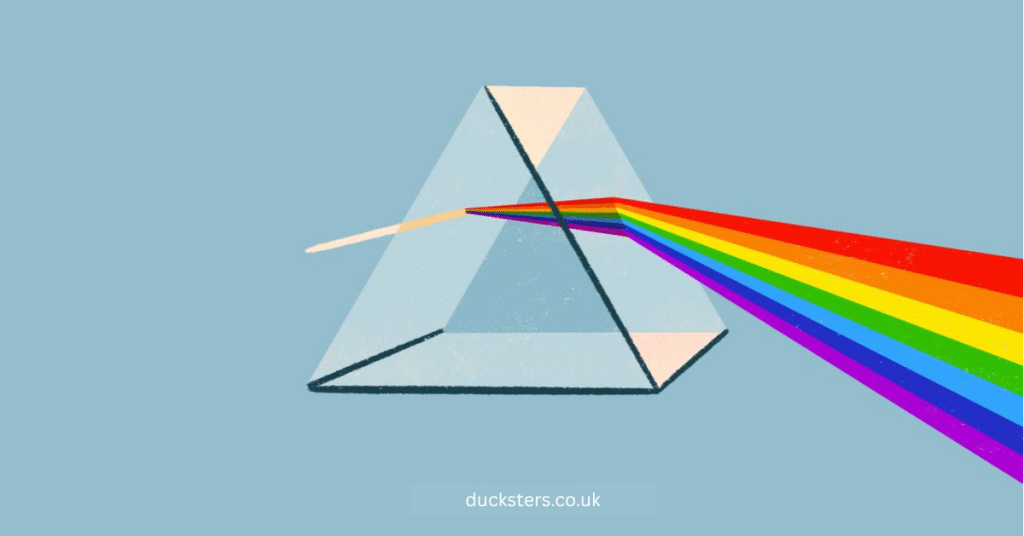
The term “Prizmatem” tells you a lot about its origins. The way that “prism” is combined with “system” or “emblem” demonstrates its primary purpose. Prizmatem systems divide complex information into discrete, interconnected layers, much like a physical prism divides light into colours.
This multi-layered approach uses a unique three-tiered structure:
- The Photon Integration Layer (PIL) converts data into visual-light patterns
- The Semantic Core Engine (SCE) uses artificial intelligence to understand user behavior and intent
- The Modular Execution Channels (MEC) break tasks into components that can run independently or together
The modular intelligence of Prizmatem is demonstrated by this architecture. Every component functions autonomously while maintaining complete integration with the overall system. Individual components can be changed, altered, or replaced by users without affecting the framework as a whole. It is therefore future-proof and flexible.
Open design principles are supported by the system, allowing developers and designers to collaborate and create solutions tailored to particular need. This collaborative strategy keeps the framework adaptable to evolving needs while accelerating innovation.
Dívat se prizmatem: a new lens for interaction
Dívat se prizmatem, which translates to “looking through a prism” in Czech, encapsulates how this technology alters our perception. Prizmatem gives digital interactions more dimension and personality rather to displaying content in a flat, linear fashion.
Live adaptability demonstrates this new interaction lens. The platforms enable real-time reactions and data changes. Users are able to respond immediately to changes as they occur. This functionality is useful in a variety of contexts. In classrooms, students can work with 3D models. Business dashboards allow managers to immediately identify patterns.
The end effect is layered, organic images that are less fake and more engrossing. These methods produce worlds in augmented reality where digital components seamlessly merge with the actual world. Gestures are used to control the technology. Everyday surfaces become responsive interfaces when hand gestures or facial expressions cause visual changes.
Prizmatem fundamentally alters our perception of visual information. It encourages multifaceted thinking and pushes producers to view digital material from a variety of perspectives, emotional contexts, and layers. The framework promotes deliberate design that emphasises user interaction and emotional connection rather than following trends.
Scientific Principles Behind Prizmatem
Multiple advanced disciplines work together to form Prizmatem’s scientific foundation. This innovative technology draws its strength from physics, materials science, and computational intelligence working together. These elements create responsive visual experiences that adapt to user needs and environmental conditions.
Photonics and light manipulation
Prizmatem’s fundamental functions are driven by sophisticated photonic principles, which also revolutionise the way light interacts with materials. The device actively manipulates light channels to provide dynamic visual displays. Through intricate wavelength modulation, stunning visual effects are created in real time.
To provide the best possible visual clarity, the system’s photonic components precisely scatter and guide light. Prizmatem uses prism-based light processes to create hyper-detailed visuals, achieving resolutions much above the capabilities and impact of typical 8K monitors.
The system makes use of light simulation algorithms that replicate the physics of light travel and take phenomena like absorption, diffusion, refraction, and reflection into consideration. These algorithms are used with specialised technology to provide realistic images regardless of the viewing angle or surrounding circumstances.
Prizmatem changes how we see our environments through advanced optics instead of just boosting images. This sophisticated light manipulation approach delivers clarity and depth that traditional materials and display technologies often lack.
Nanotechnology in material design
Prizmatem leverages nanotechnology to precisely control light through nanoscale structures, enabling dynamic displays that adapt to their environment. These structures allow surfaces to switch between transparent and opaque states instantly.
Using both top-down and bottom-up manufacturing methods, Prizmatem enhances material properties—boosting mechanical strength by over 20% and reducing thermal conductivity. This nanoscale approach supports the creation of advanced, responsive, and efficient visual technologies.
Machine learning and real-time adaptation
Prizmatem uses machine learning and AI to create dynamic, responsive visuals that adapt to user behavior and environmental changes. By learning preferences and monitoring real-time conditions, it personalizes experiences and improves over time. With live rendering, AR features, and smart sensors, Prizmatem offers an intelligent, evolving visual platform that enhances how we see and interact with digital content.
Key Use Cases in Modern Technology
Prizmatem’s unique approach to visual technology creates new possibilities for creators and users in many industries. Their technology knows how to manipulate light, adapt to conditions, and create layered visual experiences. This opens doors to applications that seemed impossible before.
AR/VR environments
Applications for virtual and augmented reality are where Prizmatem shines. It produces more realistic, layered images with depth processing capabilities. The technique enables virtual objects blend in with their environment by instantly adjusting light interaction. In augmented reality, a virtual piece of furniture would create shadows that matched the lighting in the space. This lends credibility to the entire encounter.
Users of virtual reality may see intricate light behaviours such as shifting shadows, caustics, and translucency. When touring a forest in virtual reality, one may observe reflections shimmering on water or sunshine organically penetrating through foliage. The ambient light might be changed by a meditation app to correspond with breathing patterns. This lessens eye fatigue during extended periods and produces a serene, dynamic visual flow.
User interface design
Static buttons and dropdown menus are just not enough for today’s UI. Prizmatem enables interfaces to react to energy levels, emotions, and the time of day. Depending on your level of attention or tension, the backdrop colour of a dashboard may vary. This increases productivity without diverting your attention by providing visual feedback.
Interactions go more smoothly with these adaptable interfaces. To protect your eyes, a mobile app may change its animations when you use it in low light. Interfaces that look attractive and meet your needs may now be created by designers. For everyone, this increases the experience’s accessibility and significance.
Smart lighting and home automation
The concepts of Prizmatem extend beyond displays with smart lighting systems that adjust to your surroundings, schedule, and mood. In the morning, a Prizmatem lamp would emit a chilly white radiance; at night, it might change to a gentle, warm prism-like colour. This aligns with the natural cycles of your body.
What you do might have a natural reaction in your house. The lighting changes according to your activity; it gets softer while you’re relaxing and brighter when you’re working. This ongoing connection saves energy and improves comfort while creating environments that align with your objectives.
EdTech and immersive learning
Education has transformed as a result of Prizmatem’s multi-layered visualisation technique. In the past, learning modules were static. Students may now study topics through multi-dimensional, interactive information. Students studying biology may tap a 3D model of a heart, view its chambers, observe blood flow, and contrast healthy and diseased models.
Prizmatem displays are used in modern schools to simplify difficult subjects into layers of visual information. In this approach, students can gain a deeper understanding of mathematical models or the human body. Information is simpler for visual and hands-on learners to understand and retain.
Creative tools for artists and designers
Artists and designers can explore new creative frontiers with Prizmatem’s advanced visual rendering. Digital artists can now use layered light effects, digital refractions, and texture blending in new ways. A 3D artist might use a Prizmatem plugin to create a crystal sculpture that changes color as light moves across it – without manual adjustments.
Creative professionals gain these most important advantages:
- NFT artists can create evolving digital pieces that respond to viewer interaction
- 3D modelers can build textures that reflect and refract light naturally
- AR exhibition creators can make installations react to viewer movement and distance
Prizmatem-based tools remain available to both professionals and beginners, despite their sophisticated technology. As more creators learn these capabilities, we might see completely new art forms that make use of this technology’s unique visual properties.
Benefits for Users and Developers
Prizmatem offers real benefits to users and developers beyond its technical features. The technology reshapes the scene of visual technology creation and interaction in practical, measurable ways – from visual quality to environmentally responsible features.
Enhanced visual clarity
Prizmatem stands out for its remarkable visual clarity. Realistic visual effects will be produced by the technology’s amazing accuracy in colour transitions and live light responsiveness. This clarity is naturally attained by designers who adhere to Prizmatem principles, which facilitates comprehension of complicated information.
This increased clarity makes it easier for sales teams to see trends in forecasting dashboards. More quickly than ever before, medical researchers find patterns in imaging data. Prizmatem displays maintain their remarkable clarity under difficult circumstances, providing more vivid colours and sharper contrast than conventional panels. This visual sharpness extends well beyond professional settings.
The technology’s visual excellence comes from knowing how to split light into its purest forms through layered materials with different refractive indices. The benefits go beyond looks – better visibility boosts safety in architectural designs and healthcare monitoring systems.
Energy efficiency and sustainability
The environmental benefits of the technology are astounding. Circuits that are energy-efficient reduce power consumption while increasing user comfort. There is a reduced carbon impact for both businesses and users.
Prizmatem has a lower environmental effect than many conventional synthetic and composite materials since it employs recyclable components and low-energy production techniques. By optimising the utilisation of natural light, the system reduces the demand for artificial lighting, which results in significant cost savings. Over the course of a building’s life, certain Prizmatem-inspired solutions can save yearly energy expenses by almost 50%.
Prizmatem’s commitment to environmental responsibility, supported by LEED and ISO certifications, is demonstrated by its light redirection capabilities. Materials like Prizmatem are valued highly by businesses and consumers as they prioritise achieving environmental and performance criteria.
Modular design for faster development
Prizmatem’s modular design is adored by developers. System components link seamlessly and operate independently. Developers can create systems that evolve and adapt without breaking thanks to this clever architecture, which improves user experiences while saving time and money.
APIs and plug-ins for major platforms like Unity, Unreal Engine, and WebXR make the framework more flexible, so developers can add Prizmatem easily. This modular structure speeds up development and customization, letting teams:
- Update individual components without disrupting the entire framework
- Build stronger structures that weigh less, saving on shipping and installation costs
- Adapt to new needs without major overhauls
- Scale from small implementations to larger systems over time
Cloud platforms work better with this architecture and handle millions of users reliably. Open source communities can improve specific modules without affecting the whole system.
Accessibility and user comfort
Prizmatem prioritizes user comfort by dynamically filtering harsh light, reducing eye strain during extended use. Its adaptive design supports inclusivity, aligning with visual ergonomics standards like ISO 9241-300. Durable and responsive, Prizmatem offers a long-term solution that combines performance, sustainability, and accessibility—making it ideal for a wide range of users and industries.
Limitations and Technical Challenges
Prizmatem shows impressive capabilities, but practical limitations affect how widely people adopt it. Developers and consumers should think over these challenges that range from technical requirements to user experience concerns before implementation.
Cost of materials
The price tag creates one of the most important barriers to Prizmatem adoption. Small firms often struggle with the original registration costs, though these investments pay off over time. Physical applications use prism-based materials that cost much more than regular alternatives.
Manufacturing costs depend heavily on material expenses. The specialized materials used in advanced visual technologies cost up to 10 times more than traditional options. Some specialized alloys can reach as high as USD 1200/kg.
Limited open-source tools
The Prizmatem ecosystem faces a lack of dedicated development resources. Few open-source tools exist specifically for Prizmatem technology. This creates roadblocks for independent developers and smaller studios who want to experiment with the framework.
Innovation and customization move slower compared to 10-year old technologies with strong community support. So developers often create custom solutions or adapt existing tools, which increases development time and costs.
Overuse leading to visual fatigue
I enjoy pointing out how badly executed experiences may become too dramatic or obtrusive. Eye strain is a major problem as people use digital gadgets for more than seven hours every day.
Long-term use of visually demanding technology might cause eye strain. Users complain about headaches, impaired vision, burning sensations, increased light sensitivity, and decreased blinking, which causes dry, irritated eyes. Daily tasks become more exhausting and irritating as a result of these symptoms. This restricts the amount of time users may efficiently utilise Prizmatem apps.
Conclusion
Prizmatem is a cutting-edge visual technology that revolutionises the way we engage with digital data. It improves clarity, lessens eye strain, and permits immersive experiences through special light manipulation. Its energy-efficient and flexible design promotes scalable systems and sustainable development.
Although encouraging, obstacles like exorbitant material prices and a lack of open-source tools prevent broader use. Nevertheless, Prizmatem provides opportunities for advancements in responsive architecture, smart glasses, and healthcare. It promotes multifaceted problem-solving techniques in addition to technology.
FAQs
1. What is Prizmatem?
Prizmatem is an advanced visual technology that uses light manipulation and AI to create adaptive, multidimensional digital displays.
2. How does it improve AR/VR experiences?
It enhances realism with responsive lighting, dynamic shadows, and seamless integration of virtual objects into real-world environments.
3. What are its environmental benefits?
Prizmatem reduces power use, supports recyclable materials, and boosts natural light efficiency, cutting energy costs and emissions.
4. How does it help developers?
Its modular design, APIs, and platform plug-ins simplify system building, reduce development time, and allow for scalable solutions.
5. What are its main challenges?
High hardware demands, initial costs, and limited open-source tools can hinder adoption, especially for smaller developers.
